
Free Course Explains AI Agent Harness Engineering
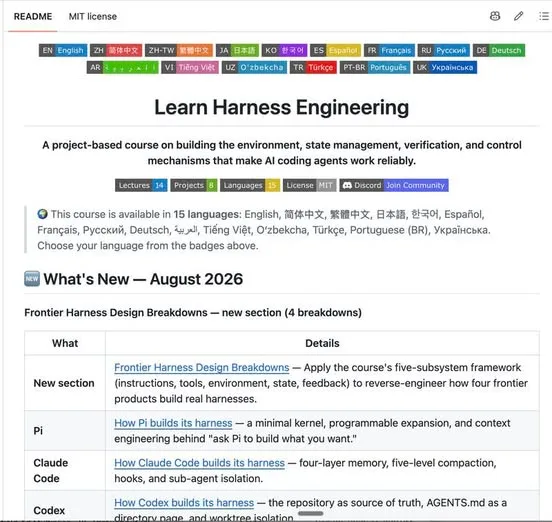
Your agent keeps fumbling the same task, and the reflex is to pay for a bigger model. This course argues the fix is not a pricier model but the harness around it. That is the scaffolding that decides when, where, and how the model works.
It is 14 lectures and 8 hands-on projects, free, MIT-licensed, and translated into 15 languages.
What Happened
An open-source course on GitHub is getting attention for one claim: when a model underperforms, the harness matters more than the price tag. The five parts it names are instructions, state, verification, scope, and lifecycle. The model still decides what code to write, but the scaffolding decides when, where, and how.
The course covers six areas:
- The 5 parts of a harness. Instructions, state, verification, scope, and lifecycle.
- Loop engineering. One agent writes, another checks its work, and you design that loop from outside it, so you stop hand-holding every step.
- Graph engineering. A loop is just a graph with one node, and it turns into a graph once you need parallel work, specialists, and recovery.
- Frontier teardowns. Claude Code's layered memory, Codex treating the repo as the source of truth, and DeepSeek's "everything is a plugin."
- A skill that scaffolds one for you. It generates the instruction files, the feature list, and a setup script, then drops a working harness into your own repo in minutes.
- An audit script. Point it at any repo and it scores all 5 parts, then shows you exactly what is missing.
Why It Matters
If your current setup is a model plus a pile of prompts, the audit script is the fast way to see how weak that really is. The five parts give you a checklist to fix it, and the scaffolding skill saves you from writing the instruction files and setup script by hand. The whole thing is free and MIT-licensed, so there is nothing to weigh before you read it.
Does this still work?
Nobody's checked yet
Sign in to tell everyone how it went.
Continue with GoogleBe the first — one tap saves the next person an hour.
It takes 3 reports in 30 days to set the status.
More shares you might like
 AIHow to Make Trampoline AI Videos for Instagram Reels4h14 views
 ToolsHow to Get 12 Months of Adobe Express Premium Free16h21 views
 ToolsHow to Use Group By in Amazon Associates Reports2d42 views
 ToolsHow to Make Fireworks AI Videos With ChatGPT and Flow2d34 views
 AIAnthropic's AI-Native SDLC Playbook, Explained3d47 views
 NewsTanStack Start 1.0 Is Stable4d56 views
Comments
Join the conversation — sign in to comment.
No comments yet — start the conversation!