
NVIDIA Open-Sources Auto Ontology, a Semantic Layer for AI Agents
Getting an AI agent to write a SQL query is the easy part. Getting it to agree on what "revenue" actually means is where things fall apart. NVIDIA has open-sourced a Python framework aimed at that exact gap.
Auto Ontology sits between your data and your agent, so a question about last month's revenue resolves to the right definition instead of whichever one it happens to hit first.
What Happened
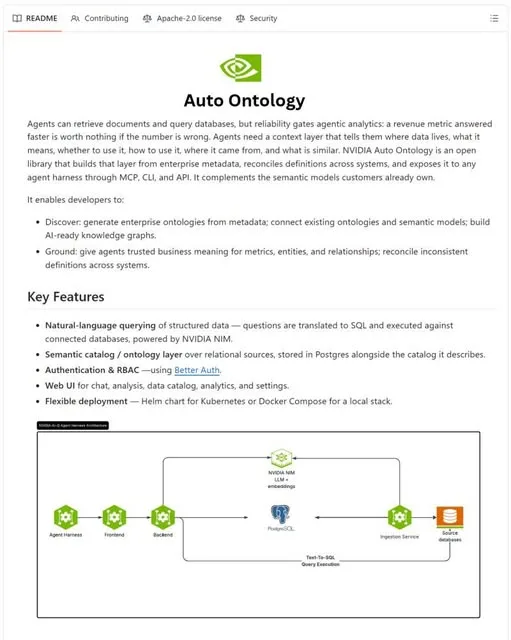
Auto Ontology is a Python framework for building semantic, graph-based reasoning layers over data. It builds a semantic catalog over enterprise metadata, so agents can reason about entities, metrics, relationships, lineage, and where trusted definitions come from.
The workflow it describes runs like this: enterprise data and metadata, into Auto Ontology, out as a semantic catalog or knowledge graph, into the AI agent, and finally out as a grounded query with provenance attached.
It can generate ontologies from metadata you already have, connect to semantic models already in place, and reconcile definitions that disagree across systems. That shared context gets exposed through MCP, CLI, or API. For structured data, it also turns natural-language questions into SQL and checks the query against the ontology and certified definitions before returning an answer.
On the source side, it currently supports relational systems including Databricks, Postgres, Snowflake, and DuckDB. It also ships an MCP server, so agents can query the same semantic layer directly.
Why It Matters
A generated query can be perfectly valid SQL and still be wrong, because it used a different revenue definition than the one your finance team certifies. That is the failure Auto Ontology is built to catch: the agent picks the definition, the tables, and the relationships deliberately, and it can show where the answer came from.
For teams running agents over enterprise data, retrieval alone was never the whole problem. The other half is a shared understanding of what the data means, and this is an open attempt at that layer.
Does this still work?
Nobody's checked yet
Sign in to tell everyone how it went.
Continue with GoogleBe the first — one tap saves the next person an hour.
It takes 3 reports in 30 days to set the status.
More shares you might like
 ToolsHow to Write Specs Coding Agents Can Build Without Guessing1d28 views
 AIParallel's Decisions API Grounds Decision Models With Live Web Search2d42 views
 How to Claim 1B Muse AI Tokens2d70 views
 ToolsHow to Use Rich Clicker Macro's Smart Auto Clicker3d44 views
 AIHow to Install hyperresearch for Deep Research in Claude Code5d58 views
 ToolsHow to Set Up Free Temp Email With XTemp Mail5d69 views

Comments
Join the conversation — sign in to comment.
No comments yet — start the conversation!