
boss-skill Turns AI Coding Agents Into a Full Dev Team
You ask an AI agent to build a feature. It sends back code, and you are left guessing: what did it plan, what did it test, and did anyone actually check whether this is safe to deploy?
An open-source project called boss-skill answers those questions by putting a whole software team around your coding agent.
It is open-source under the MIT License, and it makes the agent leave a paper trail — a PRD, an architecture doc, QA and deployment reports — so you can see the work, not just the result.
What Happened
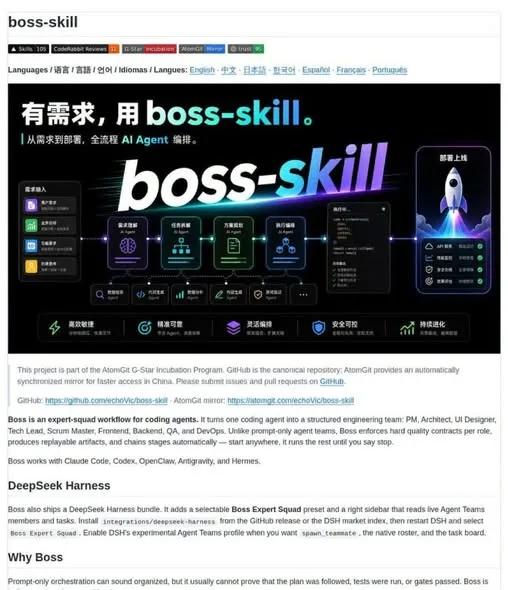
boss-skill is an open-source skill that reorganizes how an AI coding agent works. Instead of jumping straight to code, it runs the full software development life cycle: requirements, system architecture, development, testing and deployment.
It splits the job across six roles — PM, Architect, Tech Lead, Developer, QA and DevOps. Each role gets its own quality requirements and deliverables, and an automatic workflow hands the work from one stage to the next.
A few parts stand out:
- TDD workflow. Tests have to be written and failing before implementation starts, then run again until they pass.
- Quality gates. Code quality, test results and delivery requirements are checked before the project moves to the next stage or deploys.
- Traceable artifacts. The project keeps real documents: PRDs, architecture docs, task plans, QA reports and deployment reports.
- Multi-agent support. It works across Claude Code, Codex, OpenClaw, Antigravity, Hermes and DeepSeek Harness.
You do not have to run the whole pipeline every time. The command /boss:review reviews an existing codebase, and /boss:qa runs QA and writes a dedicated report. Those individual capabilities work without triggering the full SDLC.
Why It Matters
The usual complaint about AI coding agents is not that the code is bad. It is that nobody can see the reasoning behind it. boss-skill's answer is process: fixed roles, gates that block progress, and documents left behind as evidence. That is a different pitch from a faster autocomplete, and it moves the agent from writing code to following an engineering process you can audit. Whether you would hand the whole thing a production project is still your call — but at least the artifacts are there to check instead of trust.
Does this still work?
Nobody's checked yet
Sign in to tell everyone how it went.
Continue with GoogleBe the first — one tap saves the next person an hour.
It takes 3 reports in 30 days to set the status.
More shares you might like
 AIStand With Jensen Petition Passes 89,000 Signatures1d35 views
 AIHow to Break Down Any Video With rea-video2d45 views
 AIHow to Claim 1 Month of SuperGrok for Free3d74 views
 News500+ AI Agent Projects Land on GitHub With 39K Stars4d62 views
 ToolsHow to Sign Up for Amazon Associates on Your Phone4d55 views
 AIHow to Claim 20,000 Free Clocked AI API Credits5d73 views



Comments
Join the conversation — sign in to comment.
No comments yet — start the conversation!