
AI Agents Test Your Mobile App on 20 Devices at Once
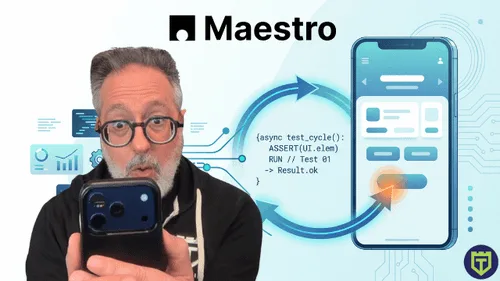
Your test suite goes green and the app still breaks on a small phone with large text. That is the gap mobile-agent-testers aims at: an open-source project that sends AI agents into your app on iOS Simulators and Android emulators to poke at it the way real people do. Each agent leaves behind a bug report with numbered screenshots showing where it got stuck.
There are no test scripts to write. The catch is cost: AI model usage runs about $0.15 to $0.55 per phone, on top of the GitHub Actions minutes, which are free for public repositories.
What Happened
mobile-agent-testers runs its AI testers in parallel through GitHub Actions, up to 20 devices at once across iPhones, Android phones, and tablets. Each agent behaves like a different user: one opens an iPhone SE with large text, another hits an Android device at 200% font size, a third uses an iPad in another language.
The agents explore instead of following a fixed path. They tap buttons, swipe, type, and try to finish tasks, then report what broke. That surfaces the things a scripted test never looks for: a button hidden behind the keyboard, a label that never changes when the language does, a screen that falls apart on a smaller display. There are accessibility checks for broken layouts, missing translations, dark mode problems, and right-to-left languages.
Two more modes are worth knowing. You can hand the agents a bug report and ask whether it reproduces across different devices, or point them at two builds or branches and compare what changed between them.
It works with Flutter, React Native, Expo, native Android and iOS, Kotlin Multiplatform, Capacitor, and .NET MAUI.
Why It Matters
Scripted regression tests are good at the scenarios you already thought of. This covers the ones nobody wrote down, which is exactly where small-screen and translation bugs live. Treat it as an extra layer before a release, not a replacement — these are exploratory runs, so an agent can misread a screen and results will vary from one run to the next.
The project is open source on GitHub, so you can read the code and its cost notes before pointing it at anything real.
More shares you might like
 AIGoogle's SynthCorp Builds Fresh Benchmarks for Data Agents1d24 views
 AIHow to Get ML.AI Infinite Free for One Month2d78 views
 ToolsHow to Reverse-Engineer a Competitor's Marketing With REM3d56 views
 AIHow to Get 12 Months of Free ChatGPT for Researchers3d90 views
 ToolsHow to Join the Amazon Influencer Program5d57 views
 ToolsHow to Make Stickman AI Animation Videos5d72 views


Comments
Join the conversation — sign in to comment.
No comments yet — start the conversation!