
Meta's Context Language Models Manage Their Own Context
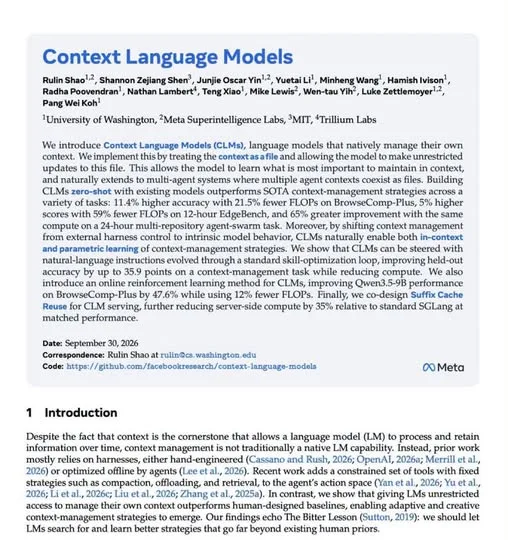
Meta researchers just introduced something they call Context Language Models, or CLMs. The idea is easy to state and hard to pull off: instead of wrapping a model in layers of RAG, orchestration, and outside context management, you train the model to handle its own context.
The reported numbers are the reason to pay attention — a 47.6% gain on BrowseComp-Plus while using 12% fewer FLOPs. If that holds up, it changes the conversation about how context gets handled.
What Happened
Context Language Models treat context as a dynamic file, not a giant text dump. The model decides for itself what to keep, what to use, and what to update as it works.
The paper reports results from online RL with Qwen3.5-9B: a 47.6% improvement on BrowseComp-Plus while using 12% fewer FLOPs. It also introduces Suffix Cache Reuse for inference, reporting 35% lower compute than standard SGLang at matched performance.
The framing is the interesting part. For years the standard answer to context limits has been more tokens, better retrieval, and smarter orchestration. Meta is asking a different question: what if the model learned to manage context on its own?
Why It Matters
If this approach scales, it touches a lot of what people build today — RAG pipelines, agent memory, context engineering, and the harnesses that hold agents together. The compute side matters too, since saving FLOPs at the same performance is the kind of gain that shows up in real bills.
This is a research result for now, not a product you can sign up for. But it is worth watching whether the same trick holds outside the benchmark.
Does this still work?
Nobody's checked yet
Sign in to tell everyone how it went.
Continue with GoogleBe the first — one tap saves the next person an hour.
It takes 3 reports in 30 days to set the status.
More shares you might like
 AIHow to Get Free Unlimited GPT-6.1 Sol API Access8h17 views
 AIHow to Get $20 of Free Perch AI Credits Monthly1d41 views
 AIEarshot v0.3 Ships 201 Code-Generated Sound Effects2d48 views
 AIHow to Make Trampoline AI Videos for Instagram Reels2d37 views
 ToolsHow to Get 12 Months of Adobe Express Premium Free3d47 views
 ToolsHow to Use Group By in Amazon Associates Reports4d60 views

Comments
Join the conversation — sign in to comment.
No comments yet — start the conversation!